Dạng 3. Chứng minh đẳng thức vectơ
Phương pháp:
- Xét hiệu của hai vế.
- Biến đổi từ biểu thức vế này sang vế kia.
- Chứng minh hai biểu thức vectơ cùng bằng một vectơ trung gian.
- Chứng minh hai biểu thức vectơ cùng bằng một biểu thức vectơ trung gian bằng cách sử dụng quy tắc trừ với điểm đầu là điểm $ O $ bất kì.
Bài tự luận Tích của một vectơ với một số · Bài 27
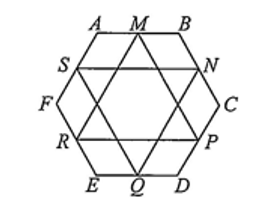
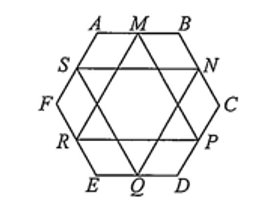
(CTST10) Cho lục giác $ABCDEF$. Gọi $M,N,P,Q,R,S$ lần lượt là trung điểm của các cạnh $AB,BC,CD,DE,EF,FA$. Chứng minh rằng hai tam giác $MPR$ và $NQS$ có cùng trọng tâm.
Xem lời giải
Lời giải
$MN$ là đường trung bình của tam giác $ABC$ nên ta có: $\overrightarrow{MN}=\frac{1}{2}\overrightarrow{AC}$.
Tương tự ta có: $\overrightarrow{PQ}=\frac{1}{2}\overrightarrow{CE}; \overrightarrow{RS}=\frac{1}{2}\overrightarrow{EA}$.
Suy ra $\overrightarrow{MN}+\overrightarrow{PQ}+\overrightarrow{RS}=\frac{1}{2}\overrightarrow{AC}+\frac{1}{2}\overrightarrow{CE}+\frac{1}{2}\overrightarrow{EA}=\frac{1}{2}(\overrightarrow{AC}+\overrightarrow{CE}+\overrightarrow{EA})=\frac{1}{2}\overrightarrow{AA}=0$.
Vậy $\overrightarrow{MN}+\overrightarrow{PQ}+\overrightarrow{RS}=0$.
Gọi $G$ là trọng tâm của tam giác $MPR$, ta có: $\overrightarrow{GM}+\overrightarrow{GP}+\overrightarrow{GR}=0$
Mặt khác:
Suy ra $\overrightarrow{MN}+\overrightarrow{PQ}+\overrightarrow{RS}=(\overrightarrow{MG}+\overrightarrow{PG}+\overrightarrow{RG})+(\overrightarrow{GN}+\overrightarrow{GQ}+\overrightarrow{GS})$
$=0+\overrightarrow{GN}+\overrightarrow{GQ}+\overrightarrow{GS}=\overrightarrow{GN}+\overrightarrow{GQ}+\overrightarrow{GS}$
(vì $\overrightarrow{MG}+\overrightarrow{PG}+\overrightarrow{RG}=-\overrightarrow{GM}-\overrightarrow{GP}-\overrightarrow{GR}=-(\overrightarrow{GM}+\overrightarrow{GP}+\overrightarrow{GR})=0$).
Do đó $\overrightarrow{MN}+\overrightarrow{PQ}+\overrightarrow{RS}=\overrightarrow{GN}+\overrightarrow{GQ}+\overrightarrow{GS}$.
Mà $\overrightarrow{MN}+\overrightarrow{PQ}+\overrightarrow{RS}=0$ nên $\overrightarrow{GN}+\overrightarrow{GQ}+\overrightarrow{GS}=0$
Vậy $G$ là trọng tâm của tam giác $NQS$.