Bài tập nâng cao · Bài 7
DẠNG 1. CỘNG TRỪ VÉC TƠ
Bài tập nâng cao Tổng và hiệu của hai vectơ · Bài 7
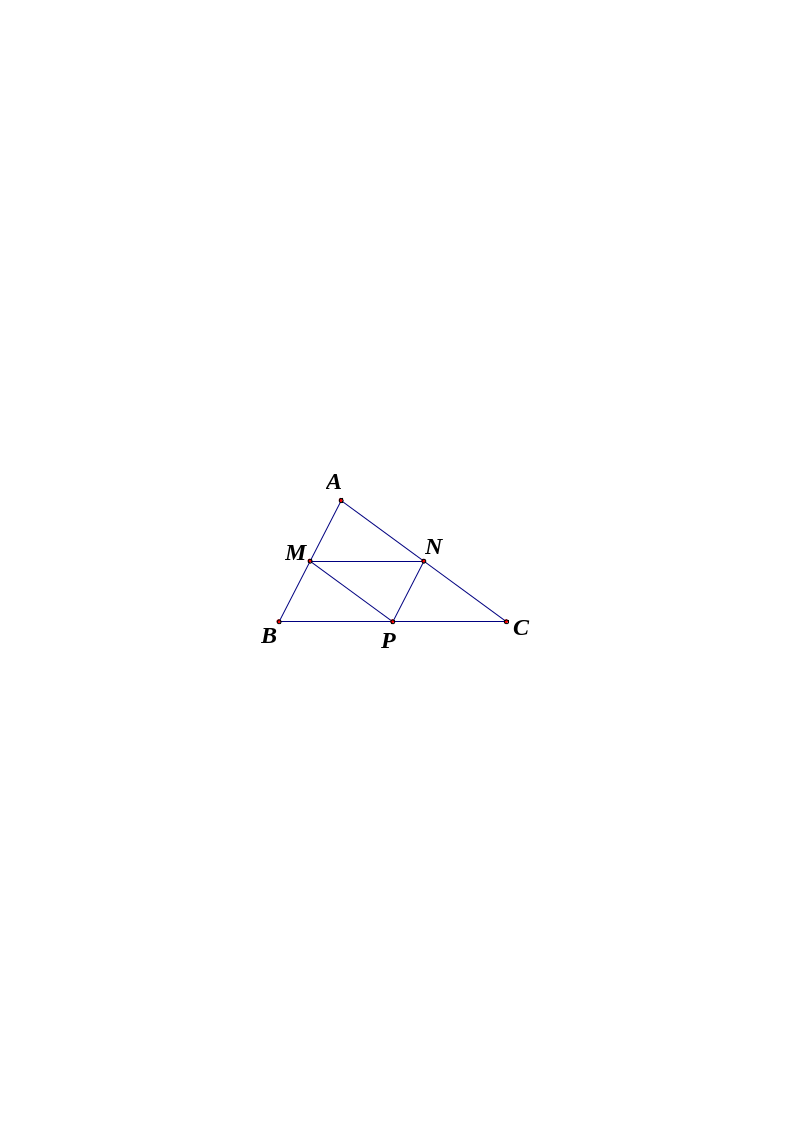
Cho tam giác $ABC$. Gọi $M$, $N$, $P$ lần lượt là trung điểm của $BC$, $CA$, $AB$. Chứng minh rằng
a) $\overrightarrow{BM}+\overrightarrow{CN}+\overrightarrow{AP}=\overrightarrow0$.
b) $\overrightarrow{AP}+\overrightarrow{AN}-\overrightarrow{AC}+\overrightarrow{BM}=\overrightarrow0$.
c) $\overrightarrow{OA}+\overrightarrow{OB}+\overrightarrow{OC}=\overrightarrow{OM}+\overrightarrow{ON}+\overrightarrow{OP}$ với $O$ là điểm bất kì.
a) $\overrightarrow{BM}+\overrightarrow{CN}+\overrightarrow{AP}=\overrightarrow0$.
b) $\overrightarrow{AP}+\overrightarrow{AN}-\overrightarrow{AC}+\overrightarrow{BM}=\overrightarrow0$.
c) $\overrightarrow{OA}+\overrightarrow{OB}+\overrightarrow{OC}=\overrightarrow{OM}+\overrightarrow{ON}+\overrightarrow{OP}$ với $O$ là điểm bất kì.
Xem lời giải
Lời giải
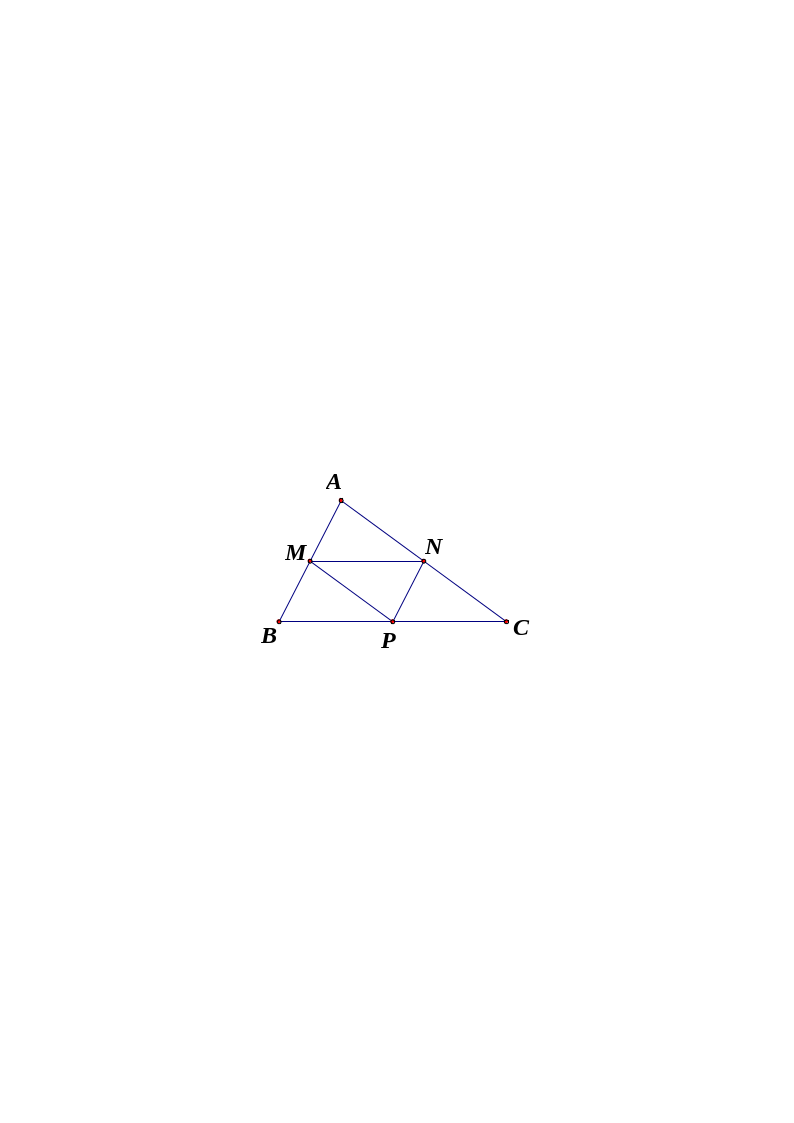
a) Vì $PN$, $MN$ là đường trung bình của tam giác $ABC$ nên $PN\parallel BM$, $MN\parallel BP$, suy ra tứ giác $BMNP$ là hình bình hành $\Rightarrow\overrightarrow{BM}=\overrightarrow{PN}$.
Vì $N$ là trung điểm của $AC\Rightarrow\overrightarrow{CN}=\overrightarrow{NA}$.
Do đó theo quy tắc ba điểm ta có
$\overrightarrow{BM}+\overrightarrow{CN}+\overrightarrow{AP}=(\overrightarrow{PN}+\overrightarrow{NA})+\overrightarrow{AP}=\overrightarrow{PA}+\overrightarrow{AP}=\overrightarrow0$.
b) Vì tứ giác $APMN$ là hình bình hành nên theo quy tắc hình bình hành ta có $\overrightarrow{AP}+\overrightarrow{AN}=\overrightarrow{AM}$, kết hợp với quy tắc trừ $\Rightarrow\overrightarrow{AP}+\overrightarrow{AN}-\overrightarrow{AC}+\overrightarrow{BM}=\overrightarrow{AM}-\overrightarrow{AC}+\overrightarrow{BM}=\overrightarrow{CM}+\overrightarrow{BM}$.
Mà $\overrightarrow{CM}+\overrightarrow{BM}=\overrightarrow0$ do $M$ là trung điểm của $BC$. Vậy $\overrightarrow{AP}+\overrightarrow{AN}-\overrightarrow{AC}+\overrightarrow{BM}=\overrightarrow0$.
c) Theo quy tắc ba điểm ta có
$\overrightarrow{OA}+\overrightarrow{OB}+\overrightarrow{OC}=(\overrightarrow{OP}+\overrightarrow{PA})+(\overrightarrow{OM}+\overrightarrow{MB})+(\overrightarrow{ON}+\overrightarrow{NC})$
$=(\overrightarrow{OM}+\overrightarrow{ON}+\overrightarrow{OP})+\overrightarrow{PA}+\overrightarrow{MB}+\overrightarrow{NC}$
$=(\overrightarrow{OM}+\overrightarrow{ON}+\overrightarrow{OP})-(\overrightarrow{BM}+\overrightarrow{CN}+\overrightarrow{AP})$.
Theo câu a) ta có $\overrightarrow{BM}+\overrightarrow{CN}+\overrightarrow{AP}=\overrightarrow0$, suy ra $\overrightarrow{OA}+\overrightarrow{OB}+\overrightarrow{OC}=\overrightarrow{OM}+\overrightarrow{ON}+\overrightarrow{OP}$.