Bài tập nâng cao · Bài 38
DẠNG 4. CHỨNG MINH SỰ VUÔNG GÓC CỦA HAI VECTƠ, HAI ĐƯỜNG THẲNG. Điều kiện $\overrightarrow a\perp\overrightarrow b\Leftrightarrow\overrightarrow a\cdot\overrightarrow b=0$. Điều kiện $AB\perp CD\Leftrightarrow\overrightarrow{AB}\cdot\overrightarrow{CD}=0$. Lưu ý chọn gốc, chọn hệ cơ sở để biểu diễn và chứng minh vuông góc.
Bài tập nâng cao Tích vô hướng của hai vectơ · Bài 38
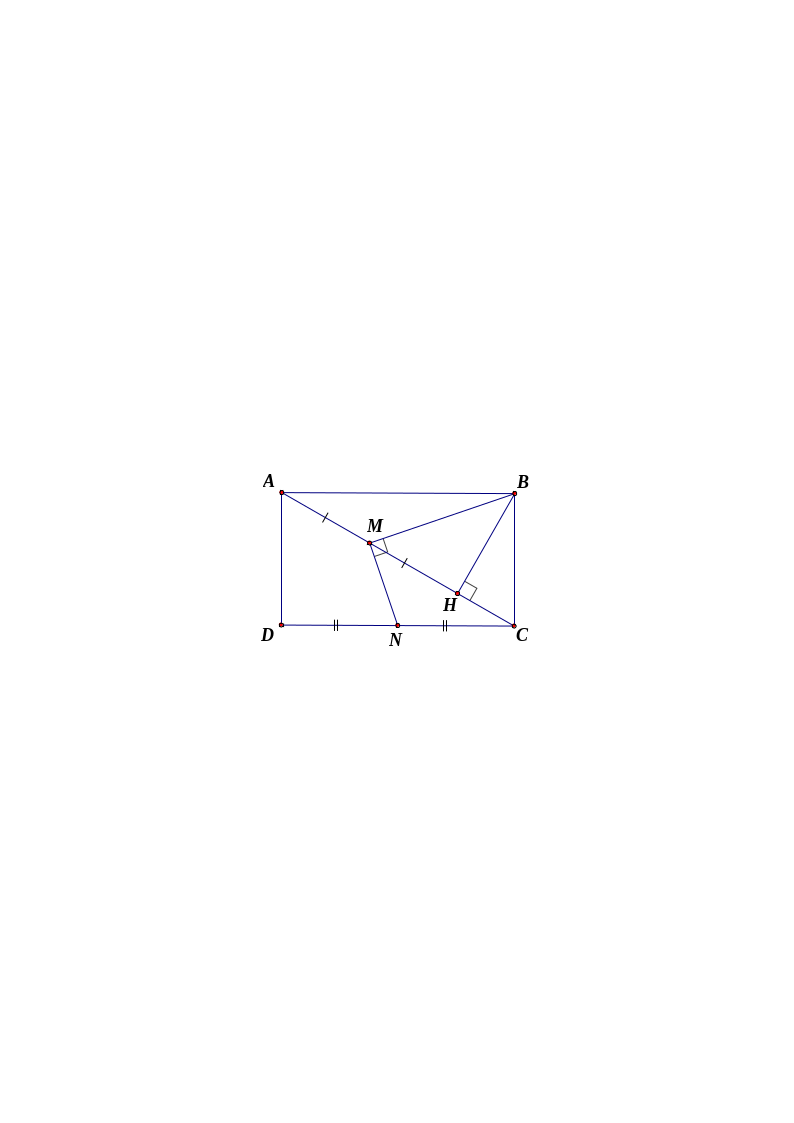
Cho hình chữ nhật $ABCD$, vẽ $BH\perp AC$. Gọi $M,N$ lần lượt là trung điểm của $AH$ và $DC$. Chứng minh $BM\perp MN$.
Xem lời giải
Lời giải
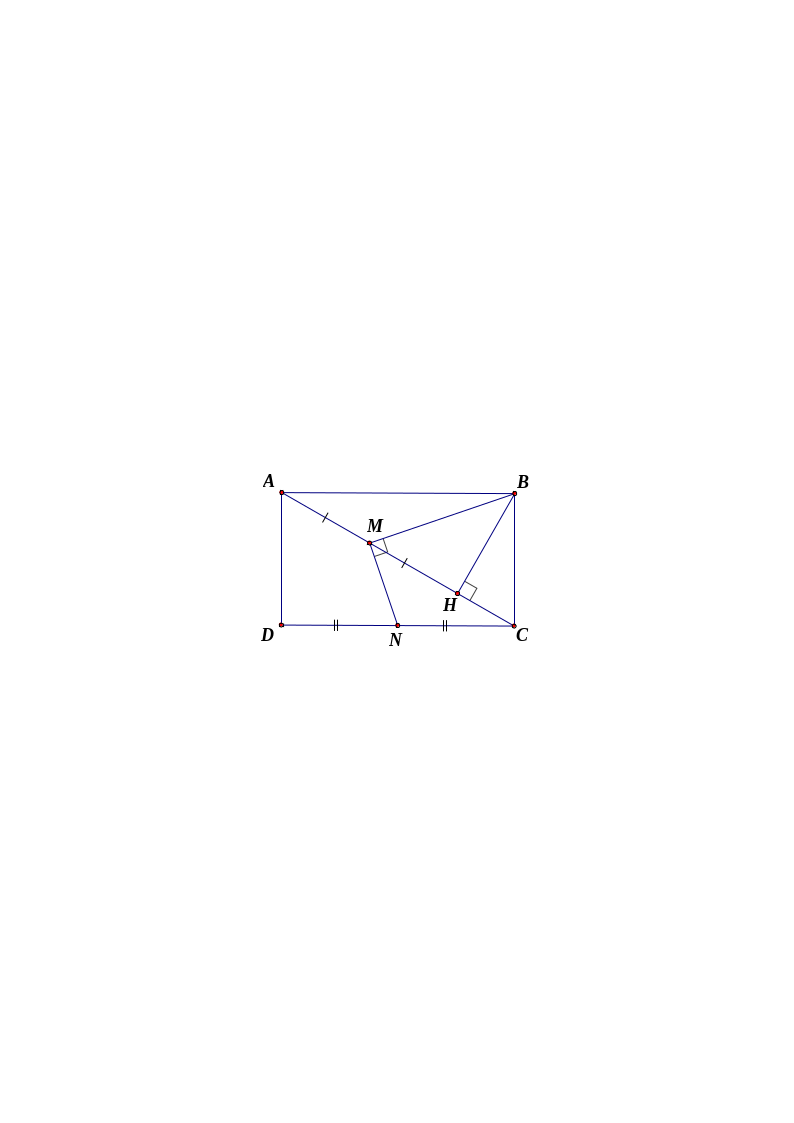
Ta có $\overrightarrow{BM}=\dfrac12(\overrightarrow{BA}+\overrightarrow{BH})$; $\overrightarrow{MN}=\dfrac12(\overrightarrow{AD}+\overrightarrow{HC})$.
Nên $\overrightarrow{BM}\cdot\overrightarrow{MN}=\dfrac14(\overrightarrow{BA}+\overrightarrow{BH})\cdot(\overrightarrow{AD}+\overrightarrow{HC})$
$=\dfrac14(\underbrace{\overrightarrow{BA}\cdot\overrightarrow{AD}}_{0}+\overrightarrow{BA}\cdot\overrightarrow{HC}+\overrightarrow{BH}\cdot\overrightarrow{AD}+\underbrace{\overrightarrow{BH}\cdot\overrightarrow{HC}}_{0})$.
Mà $\overrightarrow{BA}\cdot\overrightarrow{HC}=\overrightarrow{HA}\cdot\overrightarrow{HC}=HA\cdot HC\cos\widehat{AHC}=HA\cdot HC\cos180^\circ=-HA\cdot HC=-BH^2$.
$\overrightarrow{BH}\cdot\overrightarrow{AD}=\overrightarrow{BH}\cdot\overrightarrow{BC}=\overrightarrow{BH}\cdot\overrightarrow{BH}=BH^2$.
Từ đó suy ra $\overrightarrow{BM}\cdot\overrightarrow{MN}=0\Leftrightarrow\overrightarrow{BM}\perp\overrightarrow{MN}$.
Cách 2:
$\overrightarrow{NM}=\dfrac12(\overrightarrow{NA}+\overrightarrow{NH})=-\dfrac14(\overrightarrow{AD}+\overrightarrow{AC})+\dfrac12(\overrightarrow{NC}+\overrightarrow{CH})$
$=-\dfrac14(\overrightarrow{AD}+\overrightarrow{AC})+\dfrac12(-\dfrac12\overrightarrow{CD}+\overrightarrow{CH})$.
$\overrightarrow{BM}=\dfrac12(\overrightarrow{BA}+\overrightarrow{BH})=\dfrac12(\overrightarrow{CD}+\overrightarrow{BH})$.
Ta có $\overrightarrow{NM}\cdot\overrightarrow{BM}=[-\dfrac14(\overrightarrow{AD}+\overrightarrow{AC})+\dfrac12(-\dfrac12\overrightarrow{CD}+\overrightarrow{CH})]\cdot\dfrac12(\overrightarrow{CD}+\overrightarrow{BH})$
$=-\dfrac18(\overrightarrow{AD}+\overrightarrow{AC})\cdot(\overrightarrow{CD}+\overrightarrow{BH})+\dfrac18(-\overrightarrow{CD}+2\overrightarrow{CH})\cdot(\overrightarrow{CD}+\overrightarrow{BH})$
$=-\dfrac18(\underbrace{\overrightarrow{AD}\cdot\overrightarrow{CD}}_{0}+\overrightarrow{AD}\cdot\overrightarrow{BH}+\overrightarrow{AC}\cdot\overrightarrow{CD}+\underbrace{\overrightarrow{AC}\cdot\overrightarrow{BH}}_{0})+\dfrac18(-\overrightarrow{CD}^2-\overrightarrow{CD}\cdot\overrightarrow{BH}+2\overrightarrow{CH}\cdot\overrightarrow{CD}+\underbrace{2\overrightarrow{CH}\cdot\overrightarrow{BH}}_{0})$
$=-\dfrac18(\overrightarrow{AD}\cdot\overrightarrow{BH}+\overrightarrow{AC}\cdot\overrightarrow{CD}+CD^2+\overrightarrow{CD}\cdot\overrightarrow{BH}-2\overrightarrow{CH}\cdot\overrightarrow{CD})\quad(*)$.
Ta có:
$\overrightarrow{AD}\cdot\overrightarrow{BH}=\overrightarrow{BC}\cdot\overrightarrow{BH}=\overrightarrow{BH}\cdot\overrightarrow{BH}=BH^2$.
$\overrightarrow{AC}\cdot\overrightarrow{CD}=(\overrightarrow{AD}+\overrightarrow{AB})\cdot\overrightarrow{CD}=\underbrace{\overrightarrow{AD}\cdot\overrightarrow{CD}}_{0}+\overrightarrow{AB}\cdot\overrightarrow{CD}=\overrightarrow{AB}\cdot\overrightarrow{BA}=-AB^2$.
$\overrightarrow{CD}\cdot\overrightarrow{BH}=\overrightarrow{BA}\cdot\overrightarrow{BH}=\overrightarrow{BH}\cdot\overrightarrow{BH}=BH^2$.
$2\overrightarrow{CH}\cdot\overrightarrow{CD}=2\overrightarrow{CH}\cdot\overrightarrow{BA}=2\overrightarrow{CH}\cdot(\overrightarrow{BH}+\overrightarrow{HA})=\underbrace{2\overrightarrow{CH}\cdot\overrightarrow{BH}}_{0}+2\overrightarrow{CH}\cdot\overrightarrow{HA}$
$=2\overrightarrow{CH}\cdot\overrightarrow{HA}=2CH\cdot AH=2BH^2$.
Do đó $(*)=-\dfrac18(BH^2-AB^2+CD^2+BH^2-2BH^2)=0$.